Difference between ipv4 and ipv6
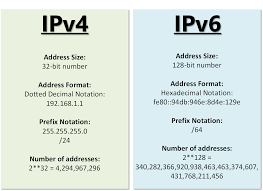
IPv4 uses 32-bit addresses, supporting ~4.3 billion devices with decimal notation (e.g., 192.168.1.1), leading to address exhaustion. IPv6 uses 128-bit addresses, providing

unique, hexadecimal-notated addresses, eliminating the need for NAT, and offering built-in IPsec security, faster routing, and automatic configuration (SLAAC).
Key Differences Between IPv4 and IPv6
- Address Space: IPv4 has a 32-bit address space (
addresses). IPv6 has a 128-bit address space (
addresses).
- Notation: IPv4 uses dotted-decimal (e.g.,
192.0.2.1). IPv6 uses hexadecimal notation separated by colons (e.g.,2001:db8::ff00:42:8329). - Configuration: IPv4 relies on manual configuration or DHCP. IPv6 supports Stateless Address Autoconfiguration (SLAAC).
- Security: IPv6 has built-in IPsec security. IPv4 security relies on application-level measures.
- Header Size: IPv4 has a variable header (20-60 bytes). IPv6 has a fixed, smaller header (40 bytes), which is more efficient for routing.
Routing/Performance: IPv6 uses multicasting and anycast, reducing network congestion. IPv4 uses broadcast.
While IPv4 is still widely used, IPv6 is required for modern, expanding networks and IoT devices due to its near-infinite address capacity.